Investor overview · September 2026

Structured notes, settled on-chain.

Autocallable notes on tokenised stocks. Fully escrowed, permissionless, priced by supply and demand instead of a dealer. Built on Robinhood Chain.

Why now

A $422bn product the chain does not have yet.

Autocallable notes sold per year
$422bnBank issued, off-chain, dealer priced. The largest structured product category in the world.
Tokenised stocks on-chain
$2.9bnGrowing fast, over 15% of RWA market cap by July 2026, yet holders have no way to earn on them or hedge them.
Robinhood Chain TVL
$536mMainnet since 1 July 2026. Stock tokens trade around the clock. Yield and protection do not exist yet.

Note Systems is the missing layer: the note desk for tokenised equities, run by contracts rather than a bank.

The problem

Two markets, one gap.

Bank notes today

  • Coupon set by the issuing desk; the investor cannot see the hedge or the margin.
  • Investor is an unsecured creditor of the bank for the life of the note.
  • Minimum tickets, paper settlement, secondary market only through the issuer.
  • Retail access limited to approved distributors and jurisdictions.

Tokenised stocks today

  • Price exposure only. No income, no protection, no options market.
  • Idle collateral: stock tokens sit in wallets earning nothing.
  • USDG holders on the chain have no equity-linked yield source.
  • Weekend and overnight gaps with no hedging venue.

Note Systems connects the two: stock holders buy protection and pay coupons; stablecoin holders earn the coupons and take the barrier risk. No bank in between.

The product

One series, two sides, no counterparty risk.

One underlying. A fixed calendar of official closes. Three levels. Both legs are escrowed in full at strike, so there is nothing to liquidate and nobody to default.

Coupon

For USDG holders

  • Deposits USDG
  • Earns a fixed coupon at every official close the barrier holds
  • Principal back in cash on autocall or maturity
  • Receives stock at the strike only if the barrier fails

The series

Coupon per observation
1.50%
Autocall, % of strike
100
Barrier, % of strike
65

Example levels. Every series sets its own.

Shield

For stock token holders

  • Posts stock tokens
  • Pays the coupons, prefunded in USDG at strike
  • Keeps the stock and any upside on autocall or maturity
  • Puts the stock at the strike if the barrier fails
  1. 1

    Subscribe

    Both sides deposit. Coupon rate is set by the ratio of SHIELD to COUPON demand, within a bounded range.

  2. 2

    Strike

    Official close fixes the strike. Matched notional locks, SHIELD prefunds every coupon in USDG, unmatched funds are refundable.

  3. 3

    Observe

    At each scheduled official close: above autocall, the series ends early and pays. Otherwise the coupon accrues.

  4. 4

    Settle

    Barrier holds, COUPON takes cash. Barrier fails, COUPON takes the stock at strike, SHIELD takes the cash.

Every price is an official exchange close read from Chainlink, cross-checked against Pyth within 3%. Any wallet can trigger a step; the first to do so earns a fixed 2 USDG from protocol fees.

The use case

Why capital shows up on both sides.

Coupon

Equity-linked income with a known worst case.

  • 1.275% net per observation at example terms, about 33% annualised
  • Downside starts only below the barrier, and then at the strike
  • No lender, no rate resets, no liquidation

Illustrative at 150 bps gross, 15% fee, 26 observations.

Shield

Protection and a fully funded put, without selling.

  • Keep the position and all upside on autocall or maturity
  • Barrier fails: sell at the strike, above market
  • Cost is the coupon stream, prefunded once at strike

Terms fixed at strike for the life of the series.

Desk

Fills COUPON when protection demand is unmet.

  • ERC-4626 shares, permissionless harvest
  • Utilisation caps at 10%, 25% and 60% by tier
  • Ordered withdrawal queue, no lock beyond live series

Counterparty of last resort, never a lender.

Figures are examples from the protocol documentation, not forecasts.

Design principle

No lender. No leverage. No liquidations.

Escrow identity, checked after every call

quoteEscrow = N_c
            + prefundRemaining
            + claimableQuote
            + refundableQuote
            + accruedFees

Every USDG in the contract is owed to a named party at all times. The same identity holds for stock tokens. It is asserted in every test that moves value and fuzzed as a stateful invariant.

Per-series isolation
A bad series cannot touch another. There is no shared pool of risk.
Pull payments only
Claims and refunds are withdrawn by the holder. The contract never pushes funds.
Official closes only
No intraday prints, no weekend prices, no oracle games. Chainlink primary, Pyth backup.
Immutable, no proxies
Solidity 0.8.28, OpenZeppelin v5.1.0, no upgrade path, no admin over user funds.
The platform

Institutional desk, retail simple.

Live on Robinhood Chain testnet. Screens captured from the production build at note.systems.

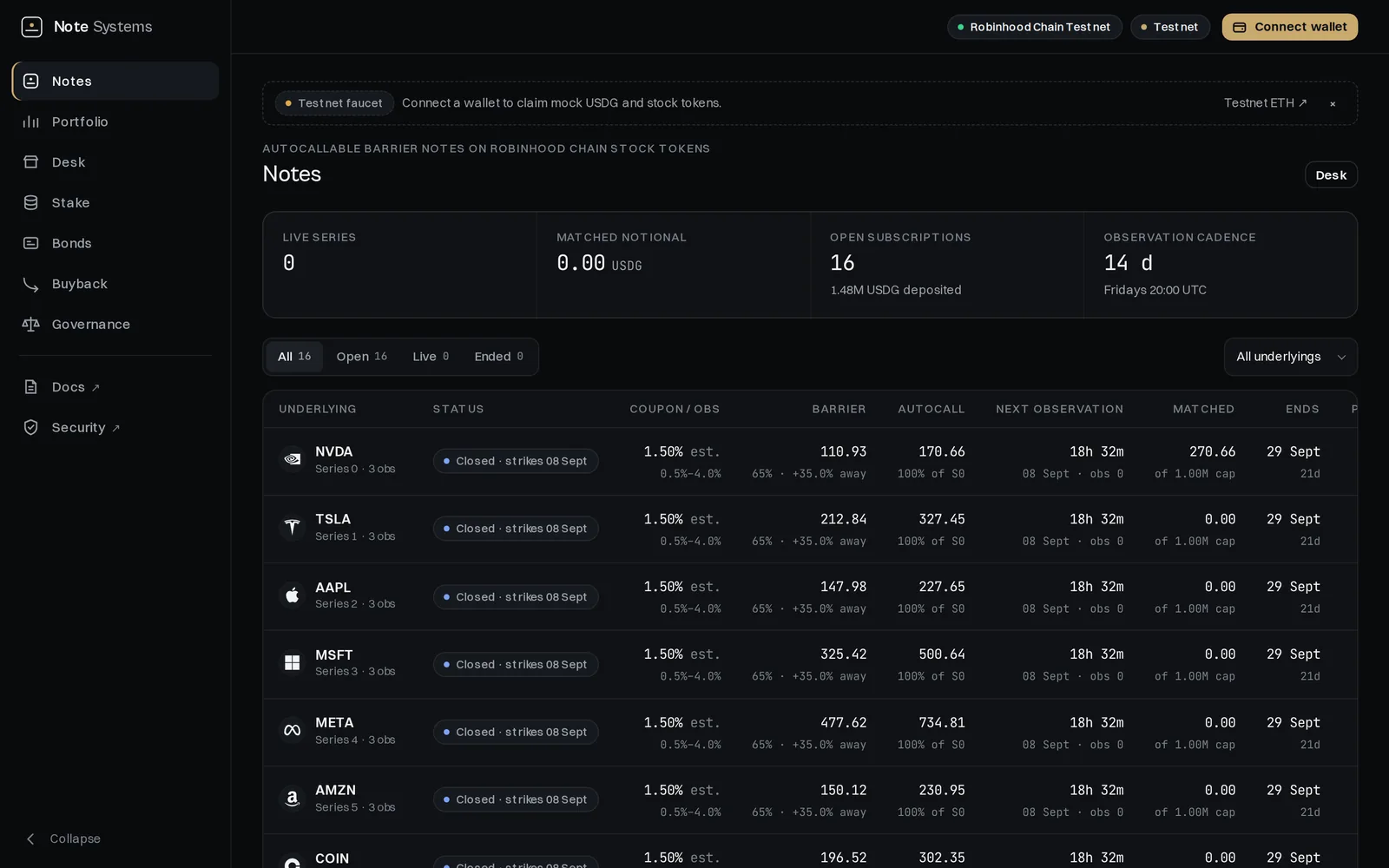
Notes board listing live series with coupon, barrier, autocall and next observation
Notes board: every live series, coupon, barrier, autocall and next observation at a glance.
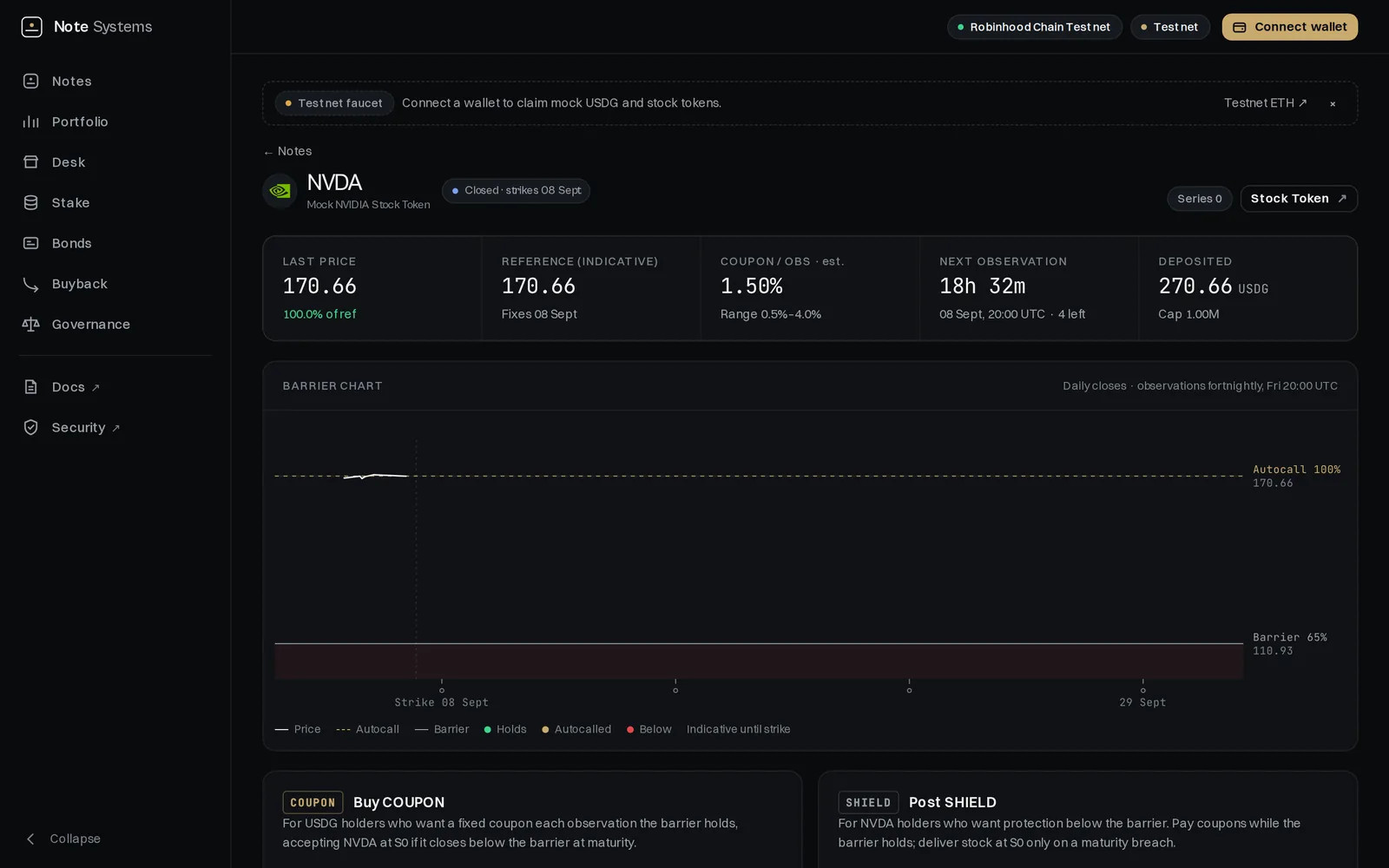
Series view showing strike, distance to barrier, coupon schedule and both legs
Series view: strike, distance to barrier, coupon schedule, and both legs side by side.
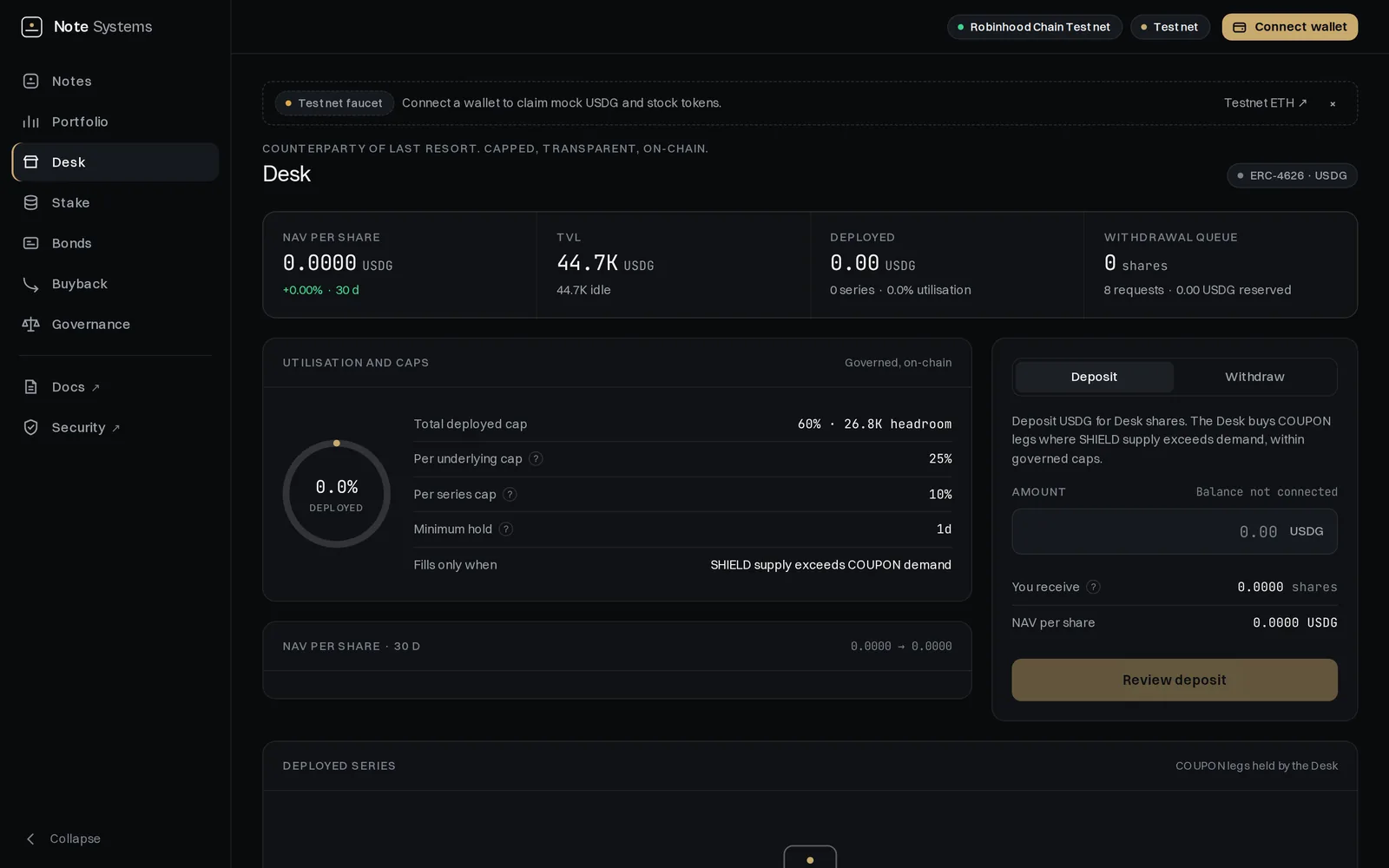
Desk vault screen
Desk USDG vault, utilisation gauge, caps by tier.
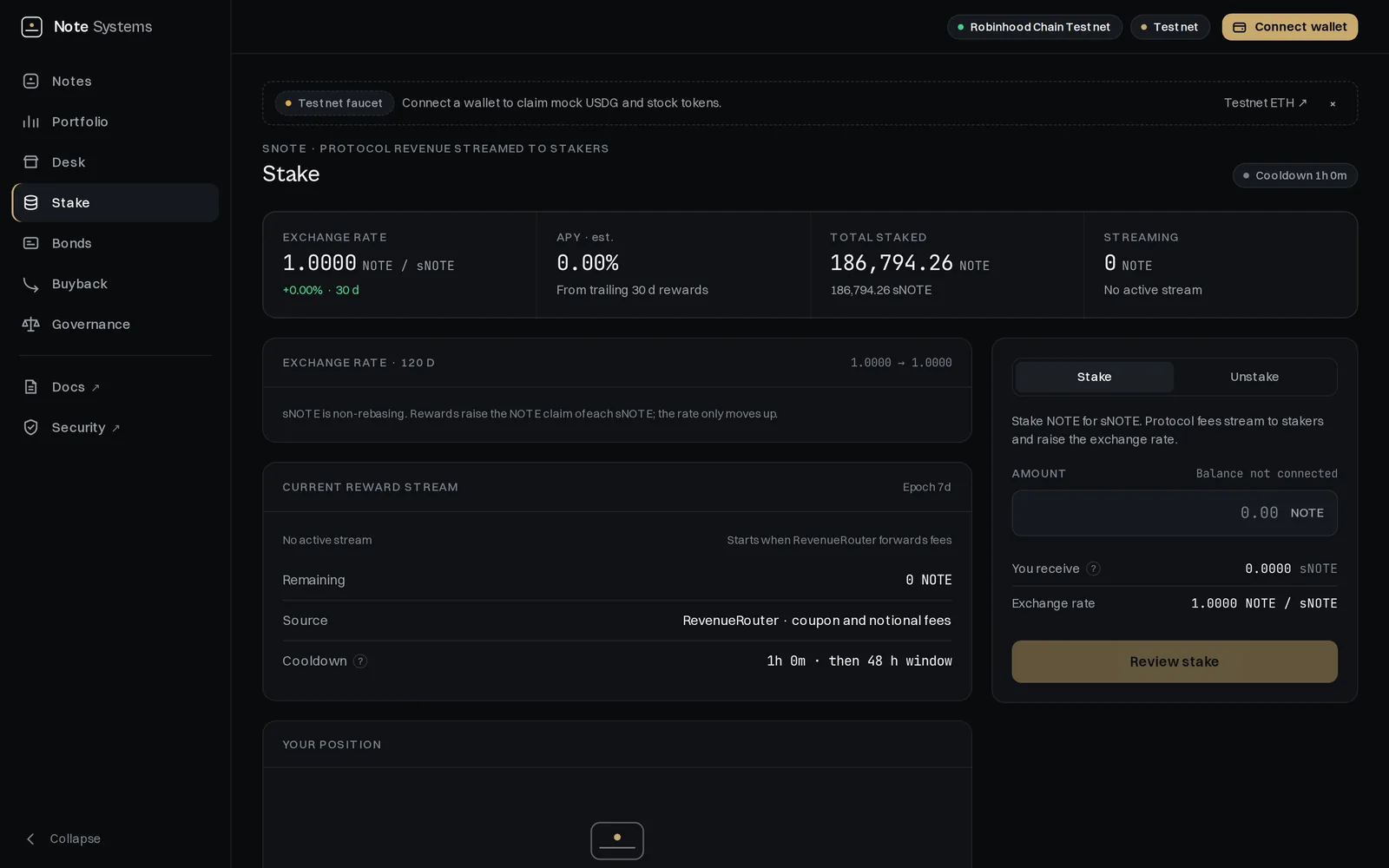
Staking screen
Stake sNOTE vault, streaming rewards, cooldown.
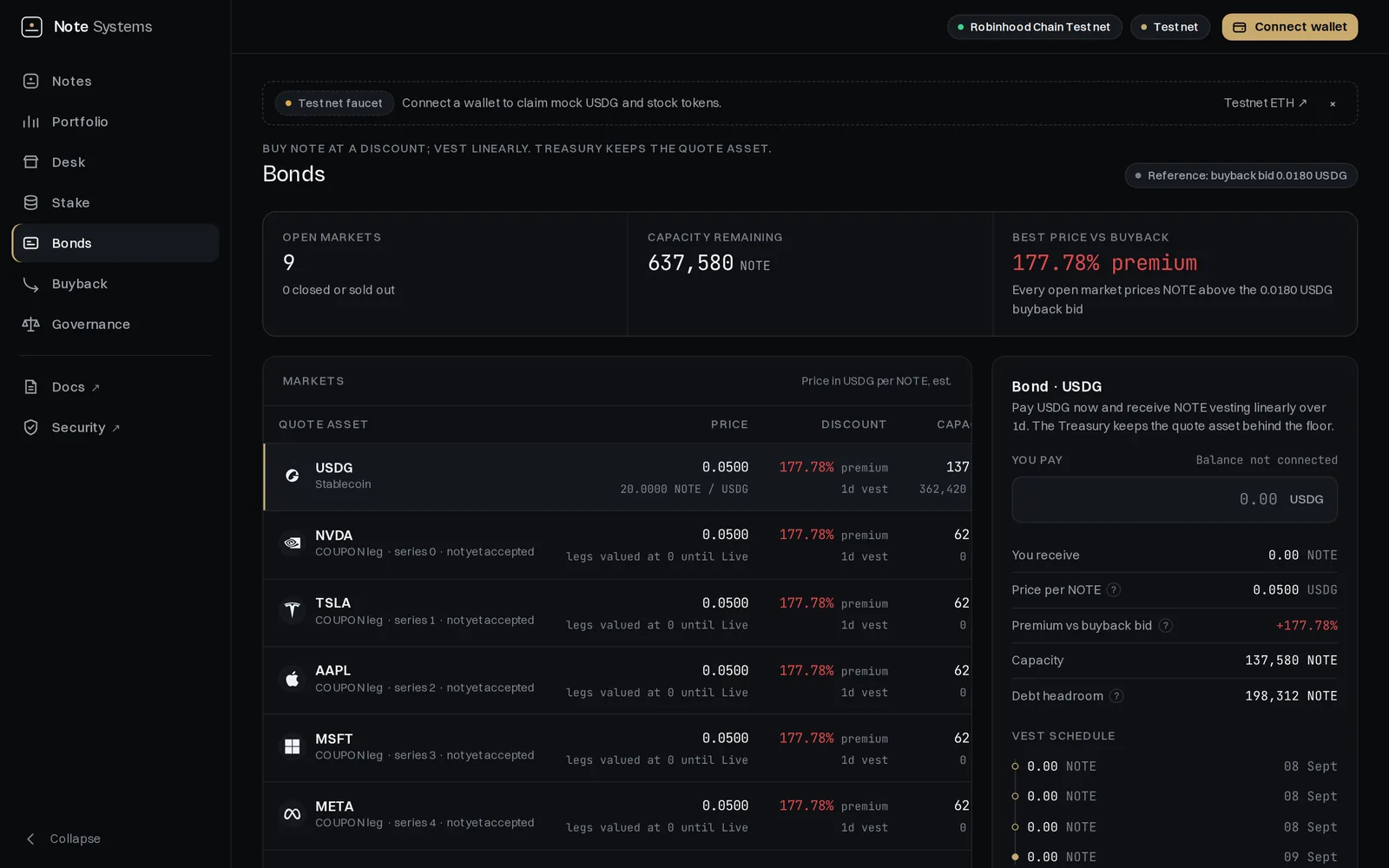
Bonds screen
Bonds Assets in, NOTE out, priced by debt ratio.
Buyback auction screen
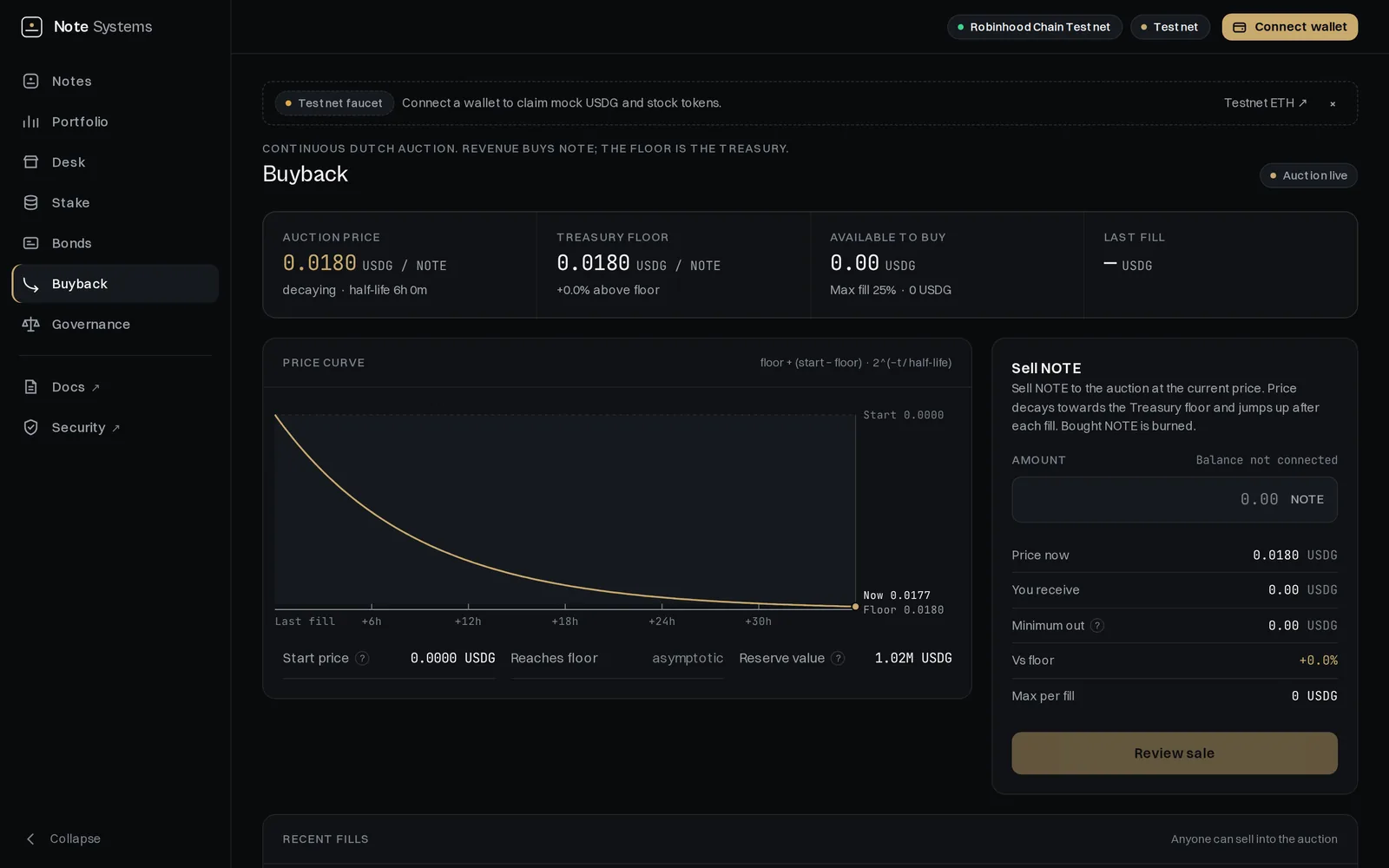
Buyback Dutch auction curve, floor from reserves.

Design system built for reading numbers: tabular figures, one accent, dark surfaces, dense tables, keyboard and screen-reader support, 375 px to 1440 px, and every state designed rather than left to chance.

Engineering

Tested like infrastructure, not like a launch.

10.9k
lines of Solidity
1,131
test functions
103
test files
41
stateful invariants
40
fuzz properties
50k
fuzz runs per property in CI
  • Unit, lifecycle, calendar (DST 2026 to 2030), oracle, automation and settlement suites
  • Coverage target 95% line and branch; differential and Monte Carlo campaigns; static analysis
  • Public documentation: every function, invariant and parameter, with facts and estimates labelled

Counts from the repository at the time of writing.

Fee design

The protocol earns most when notes work.

15%of each gross couponcouponFeeBps
0.25%of matched notional at strikenotionalFeeBps
2 USDGto whoever triggers each stepkeeperRewardQuote

Sweep to revenue router

90% buyback auction, NOTE streamed to sNOTE stakers

10% Treasury reserves behind the NOTE floor

PartyGivesGets
COUPON depositorUSDG, barrier riskCoupons net of fee, principal back or stock at strike
SHIELD depositorStock tokens, prefunded couponsPut at strike, keeps upside, stock back
Desk depositorPassive USDGCOUPON returns on the unmatched side
Anyone who cranksOne transaction2 USDG per successful step
sNOTE stakerStaked NOTE, cooldown90% of protocol fees as bought-back NOTE
TreasuryNothing10% of fees, bond proceeds, Desk returns

Worked example, 100k USDG series at 150 bps: protocol fees 917 USDG on autocall at observation 3, 6,046 at maturity, 4,696 on a barrier breach. Zero fee is charged on a coupon that is not paid.

$NOTE

Four mechanisms that convert fees into demand.

  • Buyback auction

    90% of fees buy NOTE on a Dutch curve: price decays from start to floor with a 6 hour half-life, bumps 20% after each fill, never below reserve per token.

    P(t) = floor + (start − floor)·2^(−t/6h)

  • sNOTE staking

    ERC-4626 vault. Bought-back NOTE streams to stakers over 7 days. Share price only rises. Cooldown before exit, 7 days by default.

    Rewards stream linearly, no cliffs

  • Bonds

    Sell USDG, whitelisted stock tokens or COUPON legs to the Treasury for vested NOTE at a discount. Price rises with debt ratio, falls with Desk utilisation.

    Reserve capped at 10M NOTE

  • Treasury floor

    Reserves divided by circulating supply set a redemption floor. NOTE can be redeemed for USDG at the floor, with a small haircut and daily cap.

    floor = reserves / circulating

Hard cap 100,000,000 NOTE. Fee flow buys and streams; bonds bring assets in; the floor gives every token a cash value; staking removes float. Volume in notes becomes demand for NOTE without any emissions.

Tokenomics

Fair launch. Every unit of the raise becomes liquidity.

Uniswap CCA
Continuous clearing auction, 24 hours, single clearing price for every participant.
100% to LP
The whole raise pairs with pool NOTE into Uniswap liquidity. No treasury take from the sale.
Floor 0.002 USDG
Minimum raise 20,000 USDG. Below it, every bid is refundable in full.
Verified contracts
Token, auction and vault verified on Blockscout. No proxies.

Illustrative economics

Fee revenue scales with notional, not headcount.

Assumptions

  • Fee yield 3.25% of active notional per year, midpoint of a 3.0% to 6.0% range that depends on how often series autocall
  • 90% of fees buy NOTE, 10% to reserves
  • $1bn active notional is 0.24% of annual bank autocallable sales
  • Excludes Desk returns, bond inflows and notional fees on rolls

Illustrative, not a forecast. Not a promise of returns.

Category

Nothing on-chain has done this before.

Bank autocallablesDeFi option vaultsExotic vaultsNote Systems
UnderlyingStocks, indicesBTC, ETHCrypto basketsTokenised US stocks
CounterpartyIssuing bankMarket makers via auctionWhitelisted market makersThe other side of the note, in escrow
PricingDealer margin, opaqueWeekly auction to dealersDealer quotesSupply and demand, bounded formula, on-chain
Credit riskUnsecured creditorVault and settlement riskMarket maker defaultNone: both legs prefunded, per series
SettlementCash, paperCashCashPhysical, at official closes
AccessAccredited, distributorsAnyoneAnyoneAnyone, any size, both sides

Two intermediate columns (DeFi option vaults, exotic vaults) are shown on wider screens.

Prior on-chain structured products sold vanilla or basket options to professional market makers. Note Systems is a two-sided, physically settled autocallable on single-stock tokens with no dealer anywhere in the loop.

Security

Audit first. Mainnet after.

Done

  • Internal security review of core, oracle, token, treasury and automation contracts; three written reports
  • Stateful invariant fuzzing, differential and Monte Carlo campaigns, static analysis
  • Sixteen live series on Robinhood Chain testnet, exercised through full lifecycles
  • Coordinated disclosure policy and bug bounty programme published

Next

  • Independent audit: OpenZeppelin is the intended firm, funded from protocol revenue and reserves
  • Protocol contracts stay on testnet until the audit is complete and findings are closed
  • Public report and the full contract source released with the mainnet deployment
  • Bug bounty scaled up at mainnet

Status, stated plainly: no third-party audit has been completed. The token is live on mainnet; the note protocol is not. That order is deliberate.

Security methodology

Traction

Built, verified, live.

  • LiveNOTE token on Robinhood Chain mainnet, verified source, 100M hard cap
  • LiveLaunch auction and liquidity strategy deployed and verified
  • LiveSixteen note series on testnet across AAPL, NVDA, TSLA, META, MSFT, AMZN and more
  • LiveApp, documentation site and homepage in production at note.systems
  • ReadyDesk, staking, bonds, buyback and revenue router contracts, tested and documented
  • ReadyChainlink-compatible upkeep for every scheduled step, with permissionless fallback

Vision

The structured products desk for tokenised equities.

Every stock that trades on-chain should have a yield curve and a protection market. Note Systems is the venue where those two prices are discovered, escrowed and settled without a bank.

  1. Now

    Token live. Sixteen series on testnet. Documentation and app complete.

  2. Next

    Independent audit. Protocol mainnet. First series on live stock tokens.

  3. Then

    More underlyings, index and basket notes, rolling series that renew automatically.

  4. Beyond

    Distribution partners, treasury integrations, notes as collateral across the chain.

Roadmap items after Now are plans, not commitments, and depend on audit outcomes and market conditions.

Autocallable notes for tokenised stocks. Escrowed, permissionless, settled on-chain.

This page is for information only and is not an offer, solicitation or investment advice. NOTE is a utility token of an unaudited protocol under development. Figures marked illustrative are examples, not forecasts. Digital assets can lose all value.